I don’t fence. (You’re probably not surprised because 1: I’m not very sporty, and 2: most people don’t fence.) But I know that a fencing sword is called an ÉPÉE, and the move where you stamp your front foot while advancing toward your opponent, which I have never once in my life needed to do, is called APPEL. It’s the same reason that I know the name for an officer in the Ottoman empire (3 letters: AGA) or the Greek Muse of love poetry (5 letters: ERATO). I know these words because of crossword puzzles.
Some words get lucky
What looks like a simple game is actually a kind of unexpected museum of language. Words and names that have no business surviving in everyday language get preserved in the grid because they’re useful: short and loaded with vowels or tricky letter combinations. Those words with nowhere else to live find refuge in the grid, re-taught to devotees of the puzzles each week in the New York Times. (Nobody is worshipping the Muses anymore, but ERATO is doing just fine.)
New words get a boost, too, if they serve the grid well. I like to think there’s a powerful cabal of crossword-puzzle-makers (15 letters: CRUCIVERBALISTS) who can make or break your career if you’ve got the right ratio of vowels to consonants. Oreo cookies have certainly benefited from the free marketing they get from fitting so nicely into the grid. And I’m not saying that Brian Eno wouldn’t have made it without that perfect crossword puzzle moniker, but I can certainly imagine a conversation with his manager discouraging the use of a stage name. (“With those vowels, kid, you’re going straight to the top!”) History, and the grid, have proved him right.
The grid gives you away
However, for all that power, the cruciverbalists leave a trail. Each grid is a self-portrait of its maker if you know how to read it. You can get a good sense of how old the person is (no one’s called margarine OLEO since before the boomers) and what they’re obsessed with. (NPC or BOOL? Techie. LOGE or ERI TU? Opera-phile.) You might even guess where they’re from, since JAI ALAI isn’t played that many places around the world (8 letters: GUERNICA).
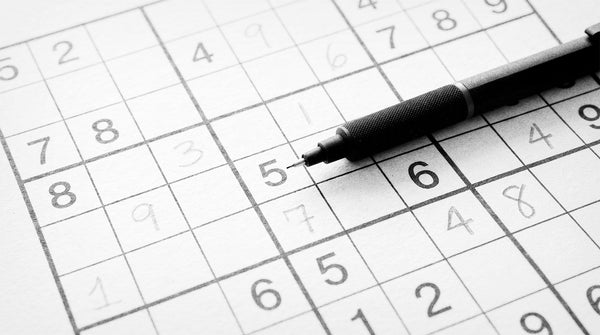
If all of that is true, then what would a Curio crossword reveal about its makers? Our passion for calipers and Japanese pencil sharpeners would come across clearly, along with an obsessive and encyclopedic knowledge of cozy detective shows. Making our own sudoku puzzles turned out to be a rabbit hole. One grid leads to another. It turns out crosswords have more rules than you’d expect, some of them charmingly antiquated, which honestly makes us want to make one even more. Are Curio Crosswords in our future? (4 letters, starting with S, meaning “before long.”)