
Sudoku Puzzles
A daily workout for the curious mind
Free sudoku for every kind of puzzle person
A good sudoku puzzle already has the answer. It's had it the whole time. It's simply waiting to find out whether you do too, which sounds a little smug when you put it that way, but is actually one of the more enjoyable negotiations a person can have with a grid. We think that kind of focused, satisfying puzzle-solving is one of life's better uses of ten minutes, especially with something warm to drink.
Daily Sudoku

Monday, 5 October 2026
Our puzzles start at Casual and climb steadily through Tricky, Challenging, and Fierce, arriving finally at Diabolical. All five are a genuine pleasure. We should mention, purely as a courtesy, that the Diabolical ones are called that for a reason. A very good reason. We believe in you completely, we just also believe in being honest.
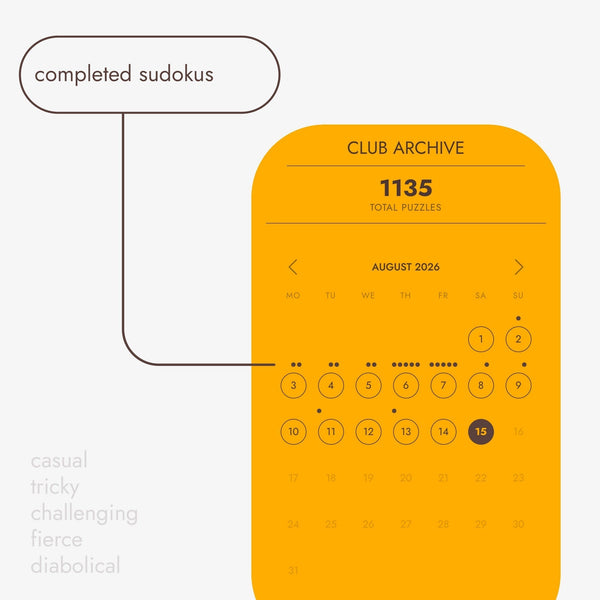
club archive
How to Play Sudoku
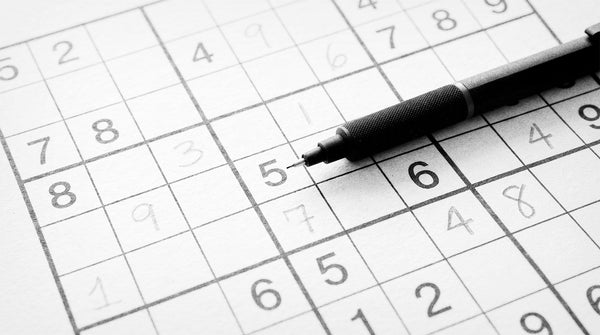
A sudoku puzzle is a 9x9 grid, divided into nine smaller 3x3 boxes. Some of the squares already have numbers in them. Your job is to fill in the rest.
The rules are these: every row, every column, and every 3x3 box must contain the numbers 1 through 9, each appearing exactly once. That's it. No mathematics required, no special knowledge, no prior experience with grids of any kind. The numbers are really just symbols. You could use nine different fruits and it would work exactly the same way. It would just be a lot messier.
The best way to start is to look for rows, columns, or boxes that are already nearly full, since those leave you fewer possibilities to work through. Each number you place will tell you something about where other numbers can and can't go. From there, one number leads to another. This is either very satisfying or very addictive. Possibly both.
About Our Difficulty Levels
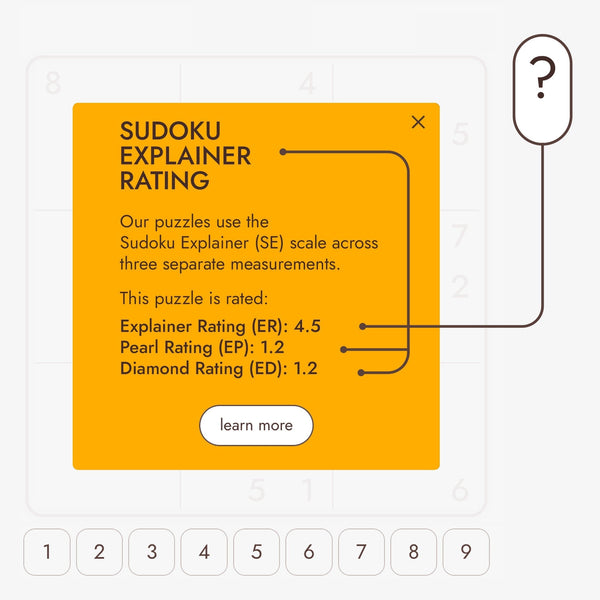
Our puzzles are rated using the Sudoku Explainer (SE) rating system, one of the most widely used standards in sudoku difficulty measurement, which is a more competitive field than you might expect. The SE system measures difficulty based on the techniques required to solve a puzzle: the higher the rating, the more advanced the approach needs to be. Each of our five difficulty levels corresponds to a specific SE rating range.
Frequently asked questions
About Sudoku
What is sudoku?
Sudoku is a logic puzzle played on a 9x9 grid, divided into nine smaller 3x3 boxes. The goal is to fill every empty cell so that each row, each column, and each 3x3 box contains the numbers 1 through 9, with no repeats. That's the whole thing. It sounds simple because it is, right up until it isn’t.
Do I need to be good at math to play sudoku?
Not even slightly. The numbers in sudoku are really just symbols: you could replace them with nine different letters, or nine different animals, and the puzzle would work exactly the same way. No adding, no multiplying, no arithmetic of any kind. Just logic, patience, and the quiet confidence that the answer is in there somewhere.
How long does it take to solve a sudoku puzzle?
It depends entirely on the difficulty level and the solver. A Casual puzzle might take ten comfortable minutes. A Diabolical one might take considerably longer, and we say that with the utmost respect for everyone who attempts them. The good news is that there is no clock, no deadline, and no one keeping score.
About Difficulty Levels
What difficulty level should I start with?
If you're new to sudoku, start with Casual. It's designed to be genuinely enjoyable without asking too much of you, and finishing one is satisfying regardless of your experience level. If you've solved sudoku before and want a bit more resistance, Tricky is a good place to land. From there, the levels climb steadily. You'll know when you're ready to move up.
What is the Sudoku Explainer (SE) rating system?
The SE rating is one of the most widely used standards for measuring sudoku difficulty, determined by the techniques required to solve a puzzle. The higher the rating, the more advanced the approach needs to be. Each of our difficulty levels corresponds to a specific SE rating range, so our labels aren't just intuitive descriptions: they're grounded in a consistent, established system.
What do the difficulty level names mean?
Our five levels run from Casual through Tricky, Challenging, and Fierce, up to Diabolical. Each name is meant to give you an honest sense of what you're in for. Casual means genuinely relaxed. Diabolical means exactly what it says, and we mean it as the highest possible compliment to the puzzle.
What's the difference between Fierce and Diabolical?
Both require advanced solving techniques and a genuine willingness to sit with uncertainty. Fierce puzzles are demanding and deeply satisfying for experienced solvers. Diabolical ones are the most technically complex puzzles we publish, requiring the most advanced techniques and the most patience. If those names sound less like a warning and more like a personal invitation, they were meant to.
About Playing and Printing
Can I solve the puzzles online, or do I need to print them?
Both, entirely up to you. The puzzles can be solved directly in your browser, or you can print them and solve on paper with a pencil in hand. We have a particular affection for the pencil-and-paper experience: there is something to be said for a freshly sharpened pencil, a clean grid, and no notifications. But the online version is there for whenever that suits you better, and it works just as well.
How do I print a puzzle?
Each puzzle page has a print button that opens a clean, print-ready version of the puzzle, formatted to fit a standard sheet of paper. Print at 100% for the most comfortable solving experience. A pencil with a good eraser is, in our view, non-negotiable.
What paper size should I use?
Our puzzles are formatted to print correctly on both standard US Letter (8.5 x 11 inches) and A4. Just make sure to print at 100% scale and everything will fit perfectly on the page, nothing cropped, nothing scaled down.
About Solving Strategies
What's the best strategy for a beginner?
Start by looking for rows, columns, or boxes that already have several numbers filled in. The more that's already there, the fewer possibilities you have to work through. Place the numbers you're certain about first, since each one will tell you something useful about where other numbers can and can't go. From there, one number leads to another. It's deeply satisfying once it starts to flow.
What should I do if I get stuck?
Step away. All joking aside, a fresh pair of eyes, even your own eyes after a cup of tea and five minutes of doing something else entirely, will often find what you missed. If you're still stuck, try scanning each row, column, and box systematically for any number that can only fit in one remaining cell. Sometimes the answer has been sitting there quietly, waiting for you to look at it from a slightly different angle.
About Curio & Co. Puzzles
How often are new puzzles posted?
Five new puzzles are posted every day, one for each difficulty level: Casual, Tricky, Challenging, Fierce, and Diabolical. Come back each day for a fresh set.
Are the puzzles free?
Yes, completely. All five difficulty levels are free to solve online or print, posted fresh every day, with no ads. No account or subscription required for today’s daily puzzles.
Can I access older puzzles?
The full archive of puzzles, going back to January 1, 2026, is available to Sudoku Solvers Club members. Membership starts at €3 per month, and anyone joining before 2027 locks in that rate as a Founding Member, even if prices go up in the future.
Will there be other types of puzzles?
Yes. Sudoku is where we're starting, but other puzzle types are in development. Check back regularly, and consider subscribing to the newsletter if you'd like to be the first to know when something new arrives.
Favorites


Tarot of Musterberg


Gadabout TM-1050 Time Machine User's Manual


Spaceman Jax - Through the Mantagon Minefield


