Somewhere on an otherwise reliable map, there may be a street that doesn’t exist. It isn’t a mistake. Someone drew it on purpose, gave it a perfectly respectable name, and told no one. (Parking is plentiful.)
The trouble with drawing an accurate map is that, if you do it well, it looks exactly like everyone else’s accurate map. The roads are where the roads are. So how do you prove that a rival copied your work instead of just looking at the same town? You add a road that isn’t there, and wait to see who else finds it. Mapmakers call this a trap street. It’s a clever system, right up until someone opens a store there.
The Small Print
The fakes can be even smaller than a street. Mapmakers are said to have added a kink to a river, an extra curve to a road, or a small building nobody has ever seen. They’re meant to go unnoticed, so it’s hard to say how many are out there.
The company behind London’s A-Z atlas was more forthcoming. In 2005, a spokesperson told a BBC program that it contained about 100 trap streets. The one the program identified, Bartlett Place, turned out to be a real walkway under a false name, reportedly borrowed from an employee. Most people get a card signed by the whole office. This one got a street.
Agloe, Population Zero
The most famous fake of all wasn’t a street, but an entire town. Around 1930, Otto G. Lindberg of the General Drafting Company and his assistant, Ernest Alpers, scrambled their initials into the name Agloe and placed it at a dirt-road intersection in the Catskills, on a map of New York State. There was nothing there, which was the whole idea.
As the story goes, Agloe later turned up on a map by their rival, Rand McNally. Lindberg and Alpers had their proof. Except that Rand McNally had an answer: Agloe was real, and there was a store to prove it. Sometime in the 1950s, someone had opened a general store at that lonely intersection. Looking for a name, they’d consulted a map from the gas company Esso, drawn by General Drafting and clearly showing that they were in Agloe. So they called it the Agloe General Store.
Lindberg and Alpers had set a trap for a thief and caught a shopkeeper.
Lunchbox for Sale, Slightly Imaginary
We have a soft spot for that shopkeeper. At Curio & Co., we’ve been making up a fictional world since 2010. We call it the Curioverse, and it’s full of comic strips that never ran, TV shows that never aired, and record labels, cereal companies, and animation studios that never existed. And people keep playing along.
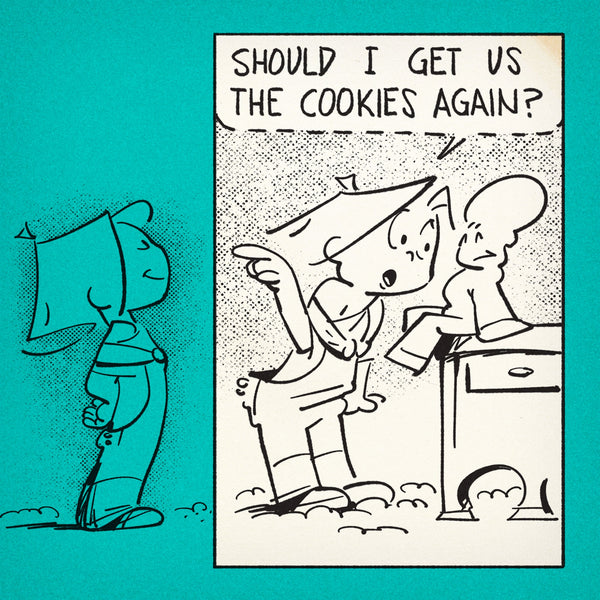
It started right from the beginning, at San Diego Comic-Con, where we launched our first book, Finding Frank and His Friend, which presented the lost images of a long-forgotten comic strip. We explained the concept carefully: the book looked like a rediscovered piece of comics history, but there had never been a comic strip, a cartoonist named Clarence ‘Otis’ Dooley, or any lost images. We’d made it all up.
“Oh, I loved Frank and His Friend,” one customer said with a wink. “I had a Frank and His Friend lunchbox when I was a kid, and my mom sold it at a garage sale for fifty cents!” He knew there was no lunchbox, and he knew that we knew. We showed him an invented world, and he walked right in and started furnishing it. We liked his addition so much that it became part of the characters’ history. Agloe got a general store. Frank and His Friend got a lunchbox that never existed, sold at a garage sale that never happened, for a very unfair fifty cents.
Hiding in Plain Sight
We plant things in our work, too: hints, inside jokes, and connections from one product to another. A mapmaker’s hidden details are there to catch someone. Ours are there for anyone who looks closely.
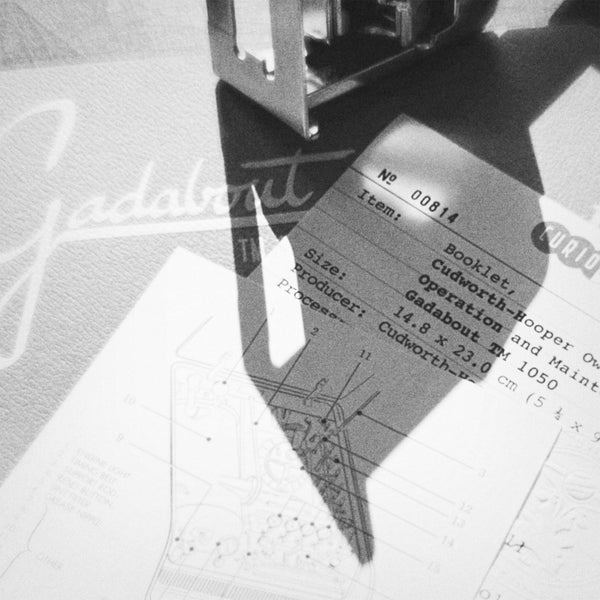
Take the Tarot of Musterberg, a deck made to look centuries old. The Emperor and Empress cards each show a shield bearing a small logo. It happens to be the logo of Cudworth-Hooper, the company that manufactured the Gadabout TM-1050 time machine from another of our books. That might explain how a deck of fortune-telling cards got so good at predicting the future: its creators could simply go and check.
We’ve never mentioned this, and in more than a decade, neither has anyone else. There are plenty more where that came from. We put them there on purpose and told no one. We’d draw you a map, but you know what mapmakers are like.