Most difficulty ratings settle for one number. A movie gets a letter, a chili pepper gets a flame icon, a wine gets a score out of 100. Sudoku puzzles usually get a simple label; ours go by Casual, Tricky, Challenging, Fierce, or Diabolical. But behind every one of those names sits something far more interesting: the Sudoku Explainer (SE) rating system, precise enough to score a single grid three separate ways.
The SE system isn’t a marketing label dressed up to sound official. It’s real software, used across a good chunk of the sudoku world, that rates a puzzle by figuring out exactly which technique a solver needs to crack it. (Stay with us, it all makes sense.)
What Is the SE Rating System
Sudoku Explainer was built by a programmer named Nicolas Juillerat, as a tool that could solve a sudoku puzzle the way a person actually would: using logic and known solving techniques, one step at a time with no brute-force guessing. (Also no coin flips, no shrugging, no calling a friend.) Along the way, though, it does something more useful than just solving the puzzle. It keeps track of exactly which technique it needed at each stage, and it grades the whole thing based on the most demanding one it had to rely on.
That’s the entire idea behind an SE rating. It isn’t a guess about how a puzzle will feel to a person sitting down with a pencil. It’s a direct verdict on what the solve actually requires. That number lives on a scale that starts at 1.0, the one number that obviously belongs in an empty cell, and climbs from there into territory most casual solvers will never wander into: chains of logic several steps long, working out what has to be true by proving what can’t be.
Sudoku Explainer’s scale has become something close to a shared language among people who build, publish, and seriously discuss sudoku, not a private measuring stick Curio & Co. invented for its own puzzles. If you’ve ever seen a puzzle described with a number like 6.2 or 3.4 and wondered what on earth that meant, now you know.
Our Five Difficulty Levels
Every Curio & Co. puzzle gets sorted into one of five levels: Casual, Tricky, Challenging, Fierce, and Diabolical. Those names are ours, chosen to describe what solving at that level is actually like. The numbers behind them aren’t ours to pick, though: each level maps to a specific band on the SE scale itself, so our label and the Sudoku Explainer’s number always agree.
Casual (SE 1.0–1.2). The bottom of the scale. Every empty cell falls to one of the two simplest techniques in sudoku, known as Last Value and Hidden Single, the sudoku equivalent of noticing there’s only one blank left in a sentence.
Tricky (SE 1.3–2.5). Still no dead ends, but the puzzle starts asking you to notice things rather than just fill things. New techniques are needed here, such as Naked Singles, Pointing, and Claiming.
Challenging (SE 2.6–3.4). This is where sudoku stops being purely about single cells. Techniques like Naked Pairs and X-Wings show up here, asking you to think about two or three cells, or two or three rows, at once.
Fierce (SE 3.5–6.1). The widest band on the scale, and it uses every inch of it. Techniques like Naked Triplets, Swordfish, XY-Wings, and Jellyfish all live somewhere in here, the kind of names that sound like they belong in a different game entirely.
Diabolical (SE 6.2–7.5). The current ceiling. Techniques such as Aligned Pair Exclusion, X-chains, and Forcing Chains, among others, are needed here, with Aligned Triplet Exclusion at 7.5 marking the toughest a Curio & Co. puzzle gets today. That cap is deliberate, not a limit of the scale itself, which keeps climbing well past it. There’s room above Diabolical if we ever decide to go there. (Don’t worry, we’re not ready for that yet either.)
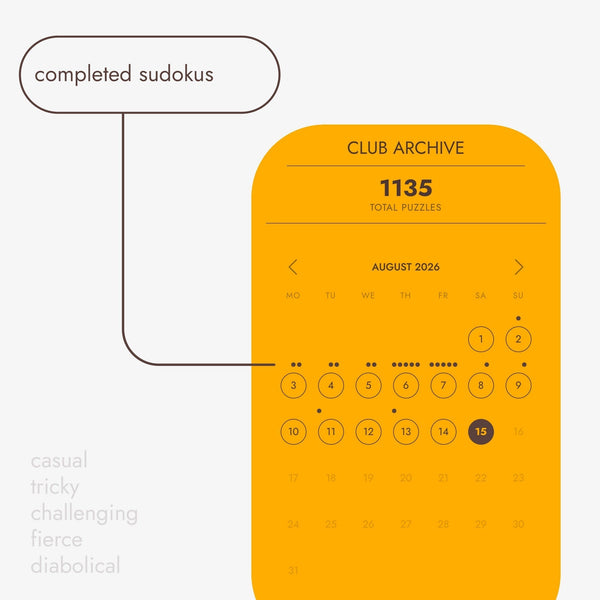
Five new puzzles go up every day, one per level, free for exactly as long as they’re the puzzle of the day. Blink, and yesterday’s Fierce quietly slips into the archive, Curio & Co.’s ever-growing back catalog of everything that’s come before, over 1000 puzzles strong and adding five more daily. Sudoku Solvers Club is what gives you access, unlocking that whole archive, every puzzle since January 2026, across all five levels.
Three Numbers, Not One
Remember that promise from the very start, that a single puzzle actually has three separate scores? Each measures a different moment in the solve. We’ve already introduced you to one of them, the Explainer Rating: it measures the hardest single technique needed anywhere in the puzzle, start to finish. But it’s just one of three ratings assigned to our puzzles. Here’s how all three actually work, in the order of the moments they’re measuring.
Picture sitting down with a fresh puzzle. You don’t start writing in numbers right away. Instead, you’re crossing off possibilities, looking at a cell, ruling out a few numbers that it obviously can’t be, and moving on. This step, eliminating possibilities, is the puzzle’s true opening move. It requires a technique, maybe a simple one maybe not, and whatever that technique is, its difficulty level is given as what we’d call the Explainer’s Diamond Rating (ED), telling you how hard it is to make your first elimination.
Now let’s keep going. If you keep crossing off more possibilities cell by cell, eventually one cell gets narrowed all the way down to a single possible number. That’s the moment you write your first actual digit into the grid. Getting to that first written number might have taken several rounds of crossing off, and the most demanding of those steps is given as what we’d call the Explainer’s Pearl Rating (EP), measuring how hard things have gotten by the time you finally write in your first digit. If ED asks about your first move, EP asks about your first win.
The solve keeps going after that, more eliminating, more numbers written in, all the way to a finished grid. Somewhere in that entire journey, one single step was harder than every other step in the whole puzzle. You might have needed that technique right at the start, maybe near the very end. Whatever that toughest technique was, from first move to last cell filled, is the Explainer Rating (ER), the main number used in our difficulty ranges from Casual to Diabolical.
Those three numbers aren’t independent facts floating around a puzzle. They nest. ED is never higher than EP, and EP is never higher than ER, always, because each one is measuring a progressively later stopping point in the exact same solve. You can’t hit a harder checkpoint before an easier one. Sometimes all three numbers land close together, other times they spread out, an easy opening, a moderate middle, one genuinely tough moment saved for later. Neither shape is better. They’re just different anatomies of the same solve.
You don’t have to take our word for any of this. Click the orange level name underneath any Curio & Co. puzzle, and you’ll see that specific puzzle’s own ER, EP, and ED, calculated the moment it was built and never recalculated after. (Look for it the next time you play one of our puzzles).
Not So Simple After All
While most things get judged by a single score, Sudoku, or at least a Curio & Co. puzzle, never has. It gets three numbers instead: one for its opening move, one for its first solved cell, one for its hardest moment overall. All of that then sorts into five levels you can read at a glance. (We never said it was simple, we only said it made sense.)
Ready to put these numbers to the test? Head to our Fun & Games page and pick your level.