It sounds like a simple counting problem, but when you ask a mathematician how many sudoku grids exist, you get three different numbers back, depending on what you’re counting. Do you mean finished grids? Or every grid that’s genuinely different, once you throw out all the duplicates? Or every actual puzzle you could sit down and play? Those all have different numbers, and they aren’t even close.
How many finished grids are there?
Let’s start with the simplest question. A finished grid is a fully completed one, where every square is filled in, and every row, column, and 3x3 box contains the digits 1 through 9 exactly once and nothing is left blank.
By 2005, sudoku was already a newspaper sensation, and people were solving puzzles everywhere. But no one had really bothered to work out how many finished grids could exist in total. So Bertram Felgenhauer and Frazer Jarvis sat down and counted. Not an estimate, an actual count, using a mix of careful logic and heavy computation, since the answer was way too large to check by hand. The answer they produced:
6,670,903,752,021,072,936,960.
That’s six sextillion, six hundred seventy quintillion, nine hundred three quadrillion, seven hundred fifty-two trillion, twenty-one billion, seventy-two million, nine hundred thirty-six thousand, nine hundred and sixty. (If that’s a bit of a mouthful, you could also round it to 667 followed by 19 zeros.)
How many of those are actually different from each other?
If you take any finished grid and rotate it a quarter turn, every number has moved to a new position on the page, but it’s still the same puzzle. Whichever numbers used to sit next to each other, in the same row, the same column, or the same box, are still next to each other in exactly the same way. You might have spun the picture, but the relationships between the numbers, who’s sharing a row with who, are completely untouched. (Do all the numbers get along? We know 6 is afraid of 7, after all.)
The same thing is true if you flip the grid, or swap every 3 for a 7 and every 7 for a 3. The positions on the page will change, but the web of relationships that makes the grid a valid sudoku, and the actual logic you’d need to solve it, would stay exactly the same. In the original puzzle, if you figured out that in a particular row you needed a 3 in a particular spot, you’ve also worked out, without realizing it, that in the new rotated puzzle, you need a 7 in the equivalent spot. You’re not solving two puzzles, you’re solving one puzzle twice. (Think of it like the same puzzle, wearing two different outfits.)
Once you go through that enormous number above and strip out every one of the repeats you get the number of truly distinct grids. Ed Russell and Frazer Jarvis worked it out later in 2005:
5,472,730,538.
But how many actual puzzles does that make?
The important point is that a finished grid isn’t a puzzle. (Where’s the fun in that?) A puzzle is what you actually sit down with over coffee: a grid with a lot of blank spots and just enough numbers filled in so that there is one way, and one way only, to fill in the rest. Turning a finished grid into a puzzle means choosing which numbers to leave out, and there are countless ways to do that. Literally. Because no one has counted this yet.
You’d need to start with that sextillion of grids we mentioned earlier and, for just one of them, go through every possible way of erasing some of the numbers so you still get exactly one solution. A single grid has 81 cells, and each one is either erased or kept, so the number of possible ways to erase from a single grid is 2 multiplied by itself 81 times. That comes out to roughly 2.4 septillion. (Not “reptilian,” which is an easy mistake.) Which means one single finished grid has more possible ways to turn it into a puzzle than there are finished grids in the entire sextillion-high pile you started with. And you’d have to do this for every single one of those sextillion grids, checking each candidate along the way to make sure it still had exactly one solution. And honestly, you probably have better ways to spend your time.
So will I run out of puzzles?
Since we can’t count the real number, let’s use the one we can, which is still plenty big enough to get a clear picture. If you take the 6.67 sextillion finished grids, and solve a different one every second, with no naps or snack breaks, you’d need 211 trillion years of nonstop solving. That’s over 15,000 times the entire history of the universe. So, no. You won’t run out of puzzles. Nobody will.
But a better answer is more a question of curation. In that countless number of puzzle possibilities, most of them will just be technically valid options, solvable but not really satisfying. You want more than that. You want a puzzle that’s worth your morning coffee. (Maybe even done on paper.)
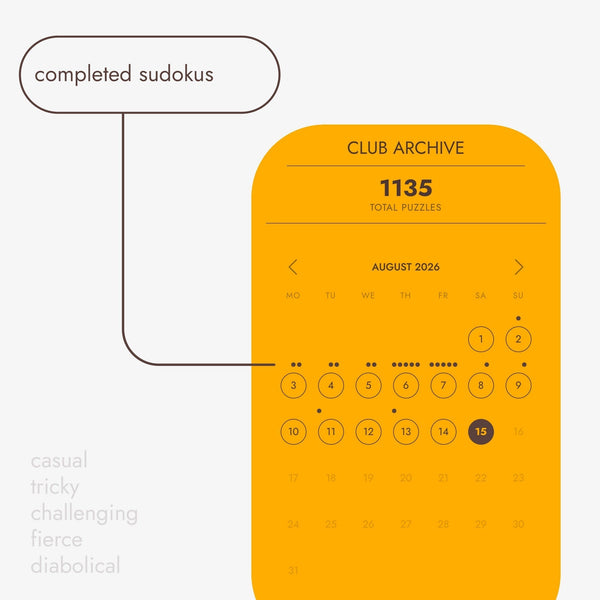
That’s the only limit to worry about. Fortunately our Sudoku Solvers Club has over a thousand of them waiting in the archive, rated and ready, going back to January 2026 and growing by five more every day. Just in case you want to get a head start on the sextillion.