Sudoku has a reputation for being harder to learn than it is. But the whole game runs on only three rules, and you can learn all three by the end of this page. What takes longer is everything underneath them: where to start, what to do when you’re stuck, and the handful of things nearly everyone assumes are rules but aren’t.
If you’re just here for today’s puzzle, it’s waiting on the Fun & Games page. If you’d rather know how the thing works first, stick around.
The Three Rules
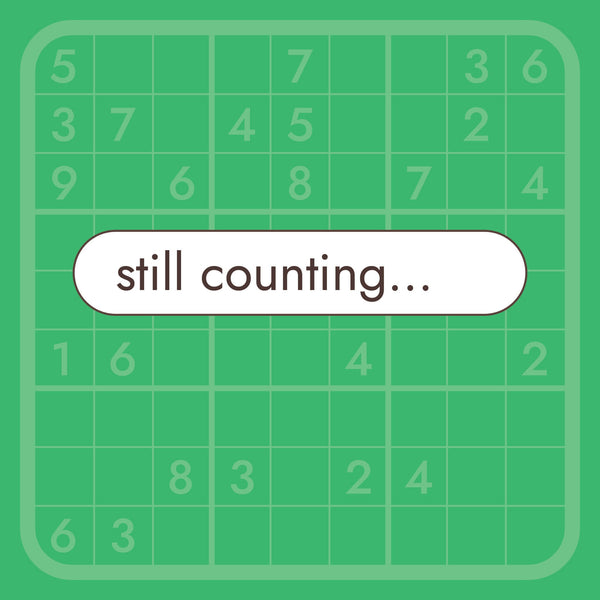
A classic sudoku grid is nine squares across and nine down, divided into nine smaller boxes of three by three. Some cells arrive with numbers already in them. Your job is to fill in the rest so that every row contains the digits 1 through 9 exactly once, every column contains 1 through 9 exactly once, and every box contains 1 through 9 exactly once. That’s it. That’s the entire game. (Really. Everything else is just reputation.)
You Don’t Need to Be Good at Math
This is the part that keeps people away, and it shouldn’t. Sudoku looks like arithmetic because it’s made of numbers, but the digits 1 through 9 are doing no math whatsoever. They’re just nine distinct symbols. You could swap them for nine letters, nine colors, or nine slightly different drawings of the same cat, and the puzzle would behave exactly the same way. Harder to typeset, admittedly. But an identical game. Nothing is ever added, multiplied, or carried. If you can tell nine things apart from one another, you are fully qualified.
Where to Start
The best opening move is wherever the grid has already done most of the work for you. Find the most crowded row, column, or box, the one with the fewest blanks left, and start there. A box with eight numbers in it is missing only one, and you can place it on sight. Each digit you write narrows down its neighbors, which narrows the row beside it, which narrows the box in the corner. The whole thing is a chain reaction in slow motion. (Nobody warns you about how satisfying this is, and by the time you notice, you’re three puzzles in.)
One thing that trips up almost everyone at first: a grid with fewer starting numbers is not automatically harder than one with more. How empty a grid looks has surprisingly little to do with how hard it is to solve. A bare-looking one might fall open in minutes, and a nearly full one might make you earn every cell.
The Rules That Aren’t Rules
Here is where sudoku collects its small myths. None of the following are actual rules, no matter how often people treat them as though they were.
There is no fourth rule. Rows, columns, boxes: that’s the complete set. So if you’ve ever heard that sudoku has twelve rules, that traces back to an old academic write-up listing twelve solving techniques, which are ways of cracking the puzzle, not laws it has to obey. Somewhere along the line “techniques” became “rules.” However, there are a great many rules for making sudoku puzzles, which we found out the hard way. (By actually making our own. Ah, the foolishness.)
The diagonals don’t count. In classic sudoku, the two long diagonals can repeat digits as freely as they like. There’s a variant called Diagonal, or X-Sudoku, where they do have to hold 1 through 9, but unless the puzzle tells you so, you can ignore them entirely.
The numbers don’t add up to anything. That’s a different puzzle: Killer Sudoku, where groups of cells add up to a target. Classic sudoku has no arithmetic in it anywhere, which follows naturally from the digits being symbols in the first place.
You can’t move the givens. The numbers printed at the start are fixed clues. You only ever fill the empty cells, and the starting numbers stay exactly where they were put.
And you never have to guess. This is the one worth keeping. Every proper sudoku has exactly one solution, and every step toward it can be reached by logic. If you find yourself guessing, you haven’t hit a wall in the puzzle. You’ve missed the deduction that gets you past it. The answer is always findable, every time. That’s a promise built into the design, not a difficulty setting.
What to Do When You’re Stuck
Stop looking at the grid. Sudoku is one of the great arguments for walking away: the cell you couldn’t crack after twenty minutes of concentration will often reveal itself within seconds of your coming back with a cup of tea. Nobody entirely understands why this works, only that it does, reliably enough to almost qualify as an official technique. (Respect the kettle.)
Will solving more puzzles at one level help you move you up to the next one? We get into why in our article on Can You Get Better at Sudoku.
About the Difficulty Levels
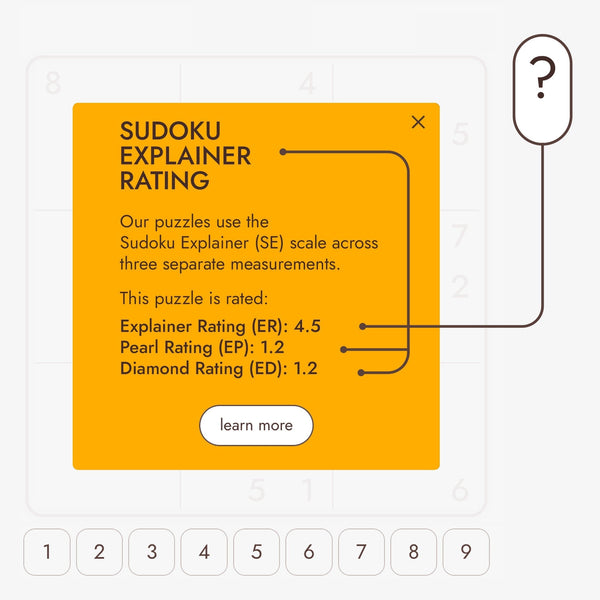
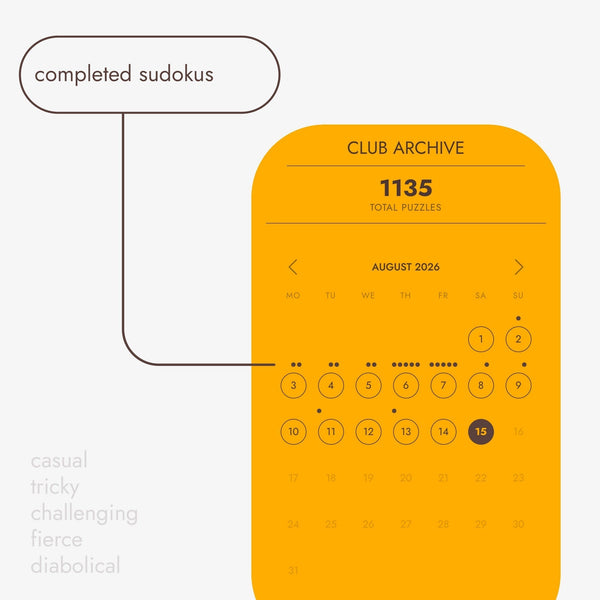
Every Curio & Co. puzzle is rated on the Sudoku Explainer (SE) scale and sorted into one of five levels, from Casual up to Diabolical. How that rating works, and why a single puzzle secretly carries three different numbers at once, is a story of its own: What Your Sudoku Rating Actually Means.
One Last Thing
Sudoku’s origins are a good deal stranger than the name suggests. It’s less Japanese than it sounds, and older than almost anyone assumes. But that’s a story for another day.
That’s the whole game, though: three rules, no math, one solution, and no guessing required. The rest is just practice, and today’s is on the Fun & Games page whenever you’re ready for it.